Contributing to MOM6
Part 1: How to contribute code back to MOM6
Date: 23/04/2026.
Presenter: Josef Bisits (@jbisits).
Benefits:
- allows for online calculation (very precise);
- could be of enduring value to the community;
- it will get maintained for you once you've contributed it!
Background
Joey did this once recently and will walk us through the steps. Today, he'll focus on diagnostics as they are a friendly place to start. A related issue is how to edit the source code and then build the model, this will be the focus of a later session. In general, one needs to
find the relevant model code --> do a calculation --> output it
Important Memory Layout Considerations
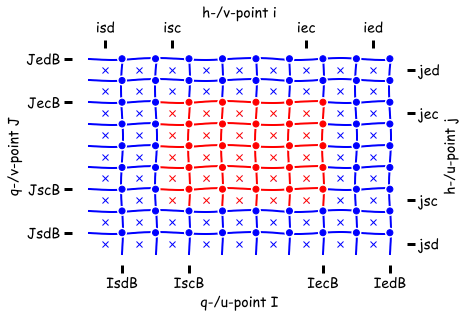
Important to be aware that there are two different types of memory non-symmetric and symmetric in MOM6. This influences where your data lives on the grid:
| Non-symmetric | Symmetric |
|---|---|
 |
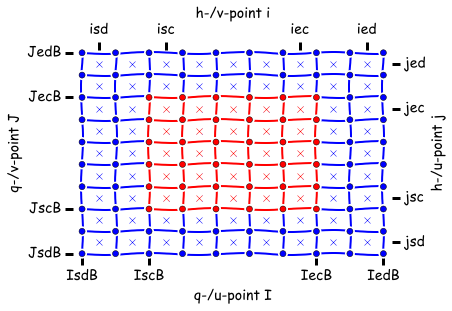 |
- the crosses (
x) are h points - faces are the
uandvpoints
Unit Systems
Another consideration is that MOM6 has internal dimensions (non-dimensionalised) and typical external units. These are documented throughout the source cod, for example:
[CU H L2 T-1 --> conc m3 s_1 or conc kg s-1]
In the above, CU is the concentration of any tracer in internal dimensions which, once transformed, becomes the physical concentration unit; see for here. For example, the internal dimension of temperature is CU but the output conc will be degrees Celsius. Additionally, in the above H is the layer thickness, L is the horizontal length and T is time which are transformed to conc m3 s-1 when the model output is saved.
One will see these kinds of statements in the headers of subroutines:
subroutine calculate_diagnostic_fields(u, v, h, uh, vh, tv, ADp, CDp, p_surf, &
                                       dt, diag_pre_sync, G, GV, US, CS)
  type(ocean_grid_type),   intent(inout) :: G    !< The ocean's grid structure.
  type(verticalGrid_type), intent(in)    :: GV   !< The ocean's vertical grid structure.
  type(unit_scale_type),   intent(in)    :: US   !< A dimensional unit scaling type
  real, dimension(SZIB_(G),SZJ_(G),SZK_(GV)), &
                           intent(in)    :: u    !< The zonal velocity [L T-1 ~> m s-1].
Calculation Process
One then does their calculation. See here for a demonstration of a subroutine that defines dimensions of inputs and outputs and carries out a calculation for an output diagnostic.
Having defined a diagnostic, for the model to output it a conversion needs to be specified so that the output data is in the correct units. The conversion is specified in when the diagnostic is registered, see the registering of the zonal mass transport which converts the internal units into kgs^-1 for output.
@jbisits has been working on a contribution on his own fork:
- https://github.com/jbisits/MOM6/tree/jib/numerical-mixing
Once one is happy with a code contribution. It is then possible, via the ACCESS-NRI MOM6 fork, to go through a process by which it gets accepted into the "upstream" mom-ocean codebase. We will cover this process in more detail in a future presentation.
Further Resources
Further background is available:
- Marshall Ward (@marshallward) on:
- Contributing to MOM6 video.
- ACCESS-NRI on MOM6 node PR testing.
- ACCESS-NRI MOM6 branch management (relevant for making contributions).
Part 2: How to contribute code back to MOM6
Date: 30/04/2026.
Presenter: Dougie Squire (@dougiesquire).
MOM6 Consortium Overview
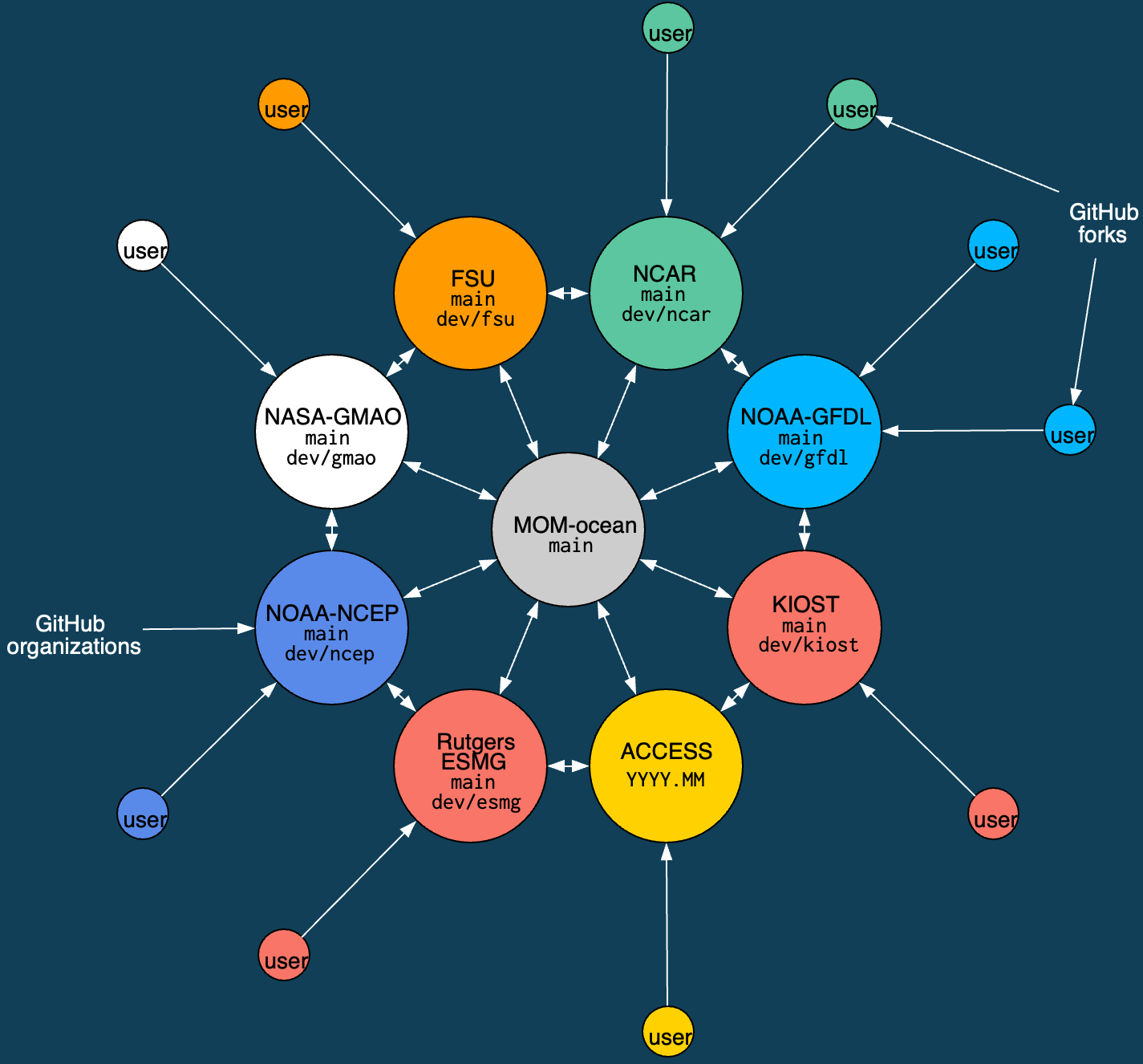 Schematic of MOM6 consortium with it's 8 development nodes.
The MOM6 Consortium
- ACCESS-NRI is a member of the MOM6 consortium.
- Contributions start at the outside and work their way in. All code contributions (preferably) go through development nodes.
- All members review/test contributions to the "official" codebase (
mom-ocean/MOM6:main). - ACCESS-OM3 is built from the ACCESS-NRI fork.
For example, Joey Bisits is working in his own fork of ACCESS-NRI's MOM6 fork, a PR will then merge Joey's code into our organisation's fork -- as part of the PR, ACCESS-NRI will do some testing. Collating several of these kinds of contributions together, we will eventually put a PR together to mom-ocean/MOM6:main. This will then be tested by all the development nodes and they all separately need to approve it before it will be merged into mom-ocean/MOM6:main. Further details of the tests ACCESS-NRI does is available here.
Fork Status and Implications
At times, the ACCESS-NRI fork is out of step with mom-ocean/MOM6:main, this occurs across all the development nodes. For example, currently on our fork, on the 2026.01 branch, it is "14 commits ahead of and 18 commits behind mom-ocean/MOM6:main".
What does this mean for me (a community person)?
- Pull requests should be made to
ACCESS-NRI/MOM6 - In practice, we prefer Pull Requests are made from branches in
ACCESS-NRI/MOM6(it makes testing easier as our infrastructure is set up there), rather than people's own personal fork. - We want to help the community contribute code. Open an issue in
ACCESS-NRI/MOM6if you are thinking about contributing something and we can chat it over and give people write access to the repository. - It may take some time for your code to reach
mom-ocean/MOM6. - We offer technical support for people's work.
Avoiding Duplicate Work
Audience question: how does one know that the thing they're working on not being worked on elsewhere?
- We can ask at the bi-weekly MOM6 developer meetings
- Look at
mom-oceanPRs and development occurring at other development nodes (e.g. gfdl) - Open an issue on the
ACCESS-NRI/MOM6fork to discuss -- it's okay to do this earlier whilst you are still working out a plan.
Additional Resources
Further information is available:
- Marshall Ward (@marshallward) on:
- Contributing to MOM6 video.
- ACCESS-NRI MOM6 branch management (relevant for making contributions).